
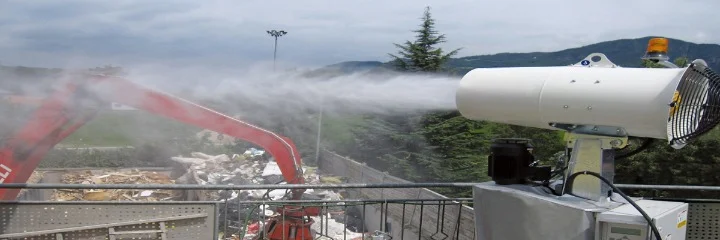
Recycling plants handle a wide range of dry, mixed, and frequently disturbed materials. That makes dust pollution a common challenge in sorting, shredding, crushing, loading, and storage operations. Because recycling facilities are often located near industrial and urban areas, dust can affect both workers inside the plant and people living or working nearby.
Where recycling plant dust comes from
The biggest sources typically include:
- Material tipping and unloading
- Shredding and crushing
- Conveyor transfer points
- Manual sorting
- Vehicle traffic
- Outdoor stockpiles
- Dry sweeping and cleanup
Mixed materials can make dust control more complicated because not all particles behave the same way.
Why recycling dust is a problem
Dust in recycling plants can reduce visibility, settle on machinery, create discomfort for workers, and increase maintenance. Workers may be exposed to repeated airborne dust during sorting and handling activities. Outdoor dust can also leave the facility boundary and create complaints from nearby businesses or residents.
Best ways to control dust in recycling facilities
The most effective recycling plant dust control plans combine process control, capture, outdoor dust management, and monitoring.
1) Enclose dusty processes
Shredders, crushers, screens, and high-drop transfer points should be enclosed as much as possible so dust does not spread through the plant. EPA recommends enclosing conveyor belts where possible and using dust curtains around transfer points to isolate dust-forming operations.
2) Install local dust capture
Extraction systems should be placed at the most active release points, such as sorting lines, shredding zones, and transfer areas. HSE recommends controlling inhalation exposure through effective general ventilation, local exhaust ventilation, and appropriate respiratory protection where necessary.
3) Control road and yard dust
Vehicle movement in yards and outdoor storage areas can be a major dust source. EPA recommends applying water or approved suppressants on unpaved roads, limiting vehicle speeds, paving heavily used roads where practical, and covering or stabilizing exposed material piles.
4) Improve cleanup practices
Dry sweeping often pushes dust back into the air instead of removing it. NIOSH found that dry sweeping in e-scrap facilities could re-aerosolize dust containing hazardous metals, and EPA’s best practices emphasize good housekeeping and prompt cleanup at spillage and transfer points.
5) Use perimeter monitoring and routine inspections
Facilities near other businesses or homes benefit from checking site-boundary dust conditions before complaints escalate. EPA recommends regular visual emissions observations for roads and dusty areas, along with inspections and housekeeping routines to catch problems early
Why Choose Us
Recycling plant dust control needs more than basic cleanup. It requires practical solutions that reduce dust at the source, improve indoor air quality, and help limit dust spread beyond the facility.
Understanding of recycling plant dust risks
We understand how dust is created during tipping, sorting, shredding, crushing, conveying, loading, and storage, and we focus on practical ways to control it before it becomes a larger problem.
Practical solutions for mixed-material facilities
Recycling plants handle many different materials, which makes dust control more complex. We support control methods that fit real processing conditions, both indoors and outdoors.
Focus on workers and nearby communities
Dust in recycling plants can affect worker comfort, visibility, equipment cleanliness, and neighboring businesses or residents. We help support cleaner and better-managed facility conditions.
Attention to indoor and outdoor dust sources
We look at both process dust inside the plant and yard dust outside the facility, because both can affect overall dust levels and site performance.
Support for better daily operations
Good dust control can improve working conditions, reduce repeated cleanup, and help prevent small dust issues from turning into larger operational problems.
Site-specific recommendations
Every recycling facility is different. We provide dust control guidance based on your equipment, material flow, traffic, storage areas, and exposure concerns.
FAQ
What causes recycling plant dust?
Dust is created during tipping, sorting, shredding, crushing, conveying, vehicle movement, stockpiling, and cleanup.
Why is recycling dust harmful?
It can affect indoor air quality, worker comfort, equipment cleanliness, and nearby communities.
How can recycling plant dust be controlled?
Common methods include process enclosure, local dust capture, yard dust control, better cleaning, and perimeter monitoring.
Can recycling dust affect nearby areas?
Yes. Dust can spread beyond the facility and affect neighboring properties.
Why is a dust control plan important?
It helps reduce exposure, improve site conditions, and control dust before it becomes a larger problem.