
Air-atomising (two-fluid) nozzles
Compressed air shears water into droplets of about 1 to 10 microns for dry fog systems at transfer points, tipplers and crusher mouths.
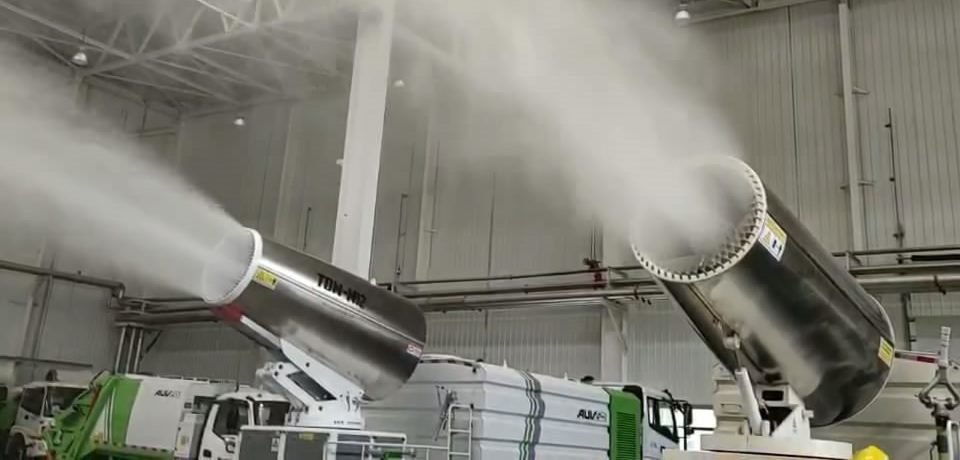
Dry fog systemThe nozzle decides whether a dust suppression system works. Droplets that are too large miss fine dust; droplets that are too small drift away. We supply and select dust control nozzles to match the dust you actually have.
Airborne dust is captured most efficiently when the water droplet is close in size to the dust particle. A large droplet pushes air, and the fine dust in it, around itself instead of colliding with it.
Each type has a job. Most installations use two or three types on the same site.
Compressed air shears water into droplets of about 1 to 10 microns for dry fog systems at transfer points, tipplers and crusher mouths.
Dry fog systemSingle-fluid nozzles with a fine orifice and anti-drip check valve, fed by a high-pressure pump, for fog lines and cannons.
Single fluid (high pressure)General-purpose water spray for wetting material on belts, at feeders and in bunkers.
Water spray systemA sheet-like spray used as a curtain across chutes, doorways and truck tipping points.
Fog curtain| Fine airborne dust in an enclosure | Air-atomising dry fog nozzle |
|---|---|
| Open area needing a mist blanket | High-pressure misting nozzle |
| Wetting material on a belt or feeder | Full cone or hollow cone nozzle |
| Curtain across an opening | Flat fan nozzle |
| Abrasive or hard water | Stainless steel body with replaceable tip and upstream filter |
Most nozzle complaints trace back to water quality. Fit a strainer finer than the smallest orifice, flush headers after installation, and keep a set of spare tips. Check spray patterns by eye every week; a streaky or one-sided pattern means the tip needs cleaning or replacing.
Send photographs, a layout or a short description of where the dust comes from.
We review each source, the material, water and power available, and any moisture limits.
You receive a layout, equipment list and price for the system that fits.
We supply, install and commission, train your operators and stay available for service.
Send photos or a layout of the dust source. An engineer will recommend a system and send a budget price.
There is no single best nozzle. Air-atomising nozzles suit fine dust in enclosed points, high-pressure mist nozzles suit open areas, and cone nozzles suit material wetting. We select after looking at the dust source.
Plain water spray nozzles commonly run at a few bar. High-pressure misting nozzles are fed by a pump at much higher pressure, and air-atomising nozzles need both water and compressed air. The exact figures come from the nozzle data sheet.
It depends on water quality and running hours. Inspect weekly, clean when the pattern degrades, and replace tips when cleaning no longer restores the pattern.
Both. We supply loose nozzles and spray bars for existing systems, and complete engineered systems with pumps, controls and piping.
Send the basics and an engineer will come back with a recommendation and a budget price.