
Perimeter rain guns and sprinklers
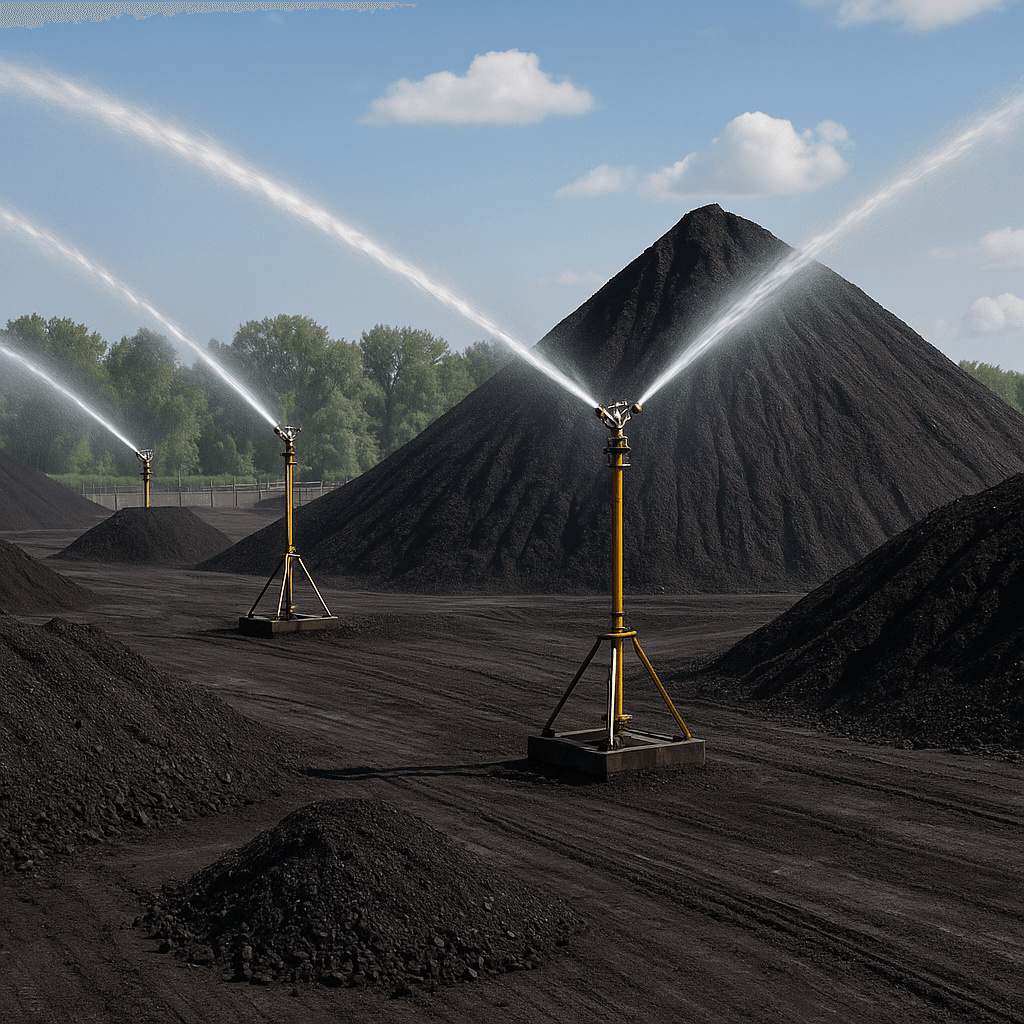
Long-throw guns on towers or risers wet the pile surface. Throws are overlapped so there are no dry strips.
Coal yard sprinklersA stockpile loses dust in two ways: wind lifts it from the surface, and stacking and reclaiming throw it into the air. Effective stockpile dust suppression treats both.
Dust emission from a pile rises sharply with wind speed and with how often the surface is disturbed. A pile that sits untouched forms a crust; a working face never does.
Stockyards are large, so the design goal is full coverage with the least water and the fewest zones running at once.
Long-throw guns on towers or risers wet the pile surface. Throws are overlapped so there are no dry strips.
Coal yard sprinklersA cannon aimed at the stacker boom or loading face captures dust in the air instead of soaking the material.
Fog cannonsPorous fencing upwind of the yard cuts wind speed over the pile and with it the dust lift-off.
Dust control fencingA sprayed binder forms a crust on long-term piles so they need far less water.
Dust suppression chemicalsWe work from a scaled yard drawing showing pile footprints, heights and the prevailing wind. Rain gun positions are set so that throws overlap, the pump is sized for the largest zone, and zones are sequenced so the whole yard is covered in one cycle. For coal and other materials sold by weight, moisture addition is checked against your quality limits.
Send photographs, a layout or a short description of where the dust comes from.
We review each source, the material, water and power available, and any moisture limits.
You receive a layout, equipment list and price for the system that fits.
We supply, install and commission, train your operators and stay available for service.
Send photos or a layout of the dust source. An engineer will recommend a system and send a budget price.
Wet the surface with zoned rain guns, capture dust at stacking and reclaiming with fog cannons or dry fog, shelter the yard with wind fencing, and crust any pile that will stand for weeks.
It depends on yard area, climate and how often each zone runs. Zoning, timers and wind-speed triggers keep consumption down, and binders can reduce it further on dormant piles.
Yes. A porous fence lowers the wind speed over the area behind it, which is what drives dust lift-off. It works best combined with surface wetting.
Yes. An anemometer can start selected zones when wind speed passes a set point, and stop them when it drops.
Send the basics and an engineer will come back with a recommendation and a budget price.