
Better airborne dust control
Cold fog is highly effective in controlling fine floating dust particles before they spread into nearby areas.
Cold fog is fog produced at ambient temperature by atomising water, with no heat involved. It targets the fine, respirable dust that coarser sprays miss.
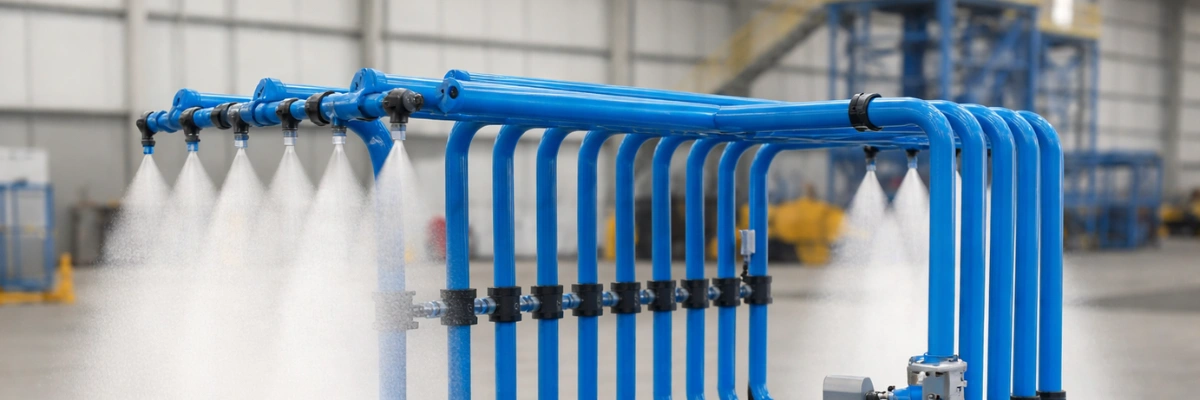
A cold fog dust suppression system is an advanced dust control solution designed to reduce airborne dust in industrial, commercial, and material handling environments. It works by generating ultra-fine mist droplets that interact with suspended dust particles and help bring them down before they spread across the work area. This makes it a practical and efficient solution for sites where reliable dust suppression is important.Unlike conventional water spraying, cold fog technology focuses on producing fine droplets that stay longer in the air and provide better contact with floating dust. This allows the system to control airborne particles more effectively while using water in a more controlled manner. For industries dealing with crushers, transfer points, stockyards, loading areas, and open dusty zones, a cold fog dust suppression system can offer better dust management and cleaner site conditions.

A cold fog dust suppression system is a specially designed system that uses fine mist to control dust in industrial and outdoor environments. The system produces a fog-like spray without heat, which is why it is known as cold fog. These fine droplets mix with airborne dust particles, making them heavier so they settle instead of remaining suspended in the air.This type of dust suppression is commonly used in areas where fine airborne dust is generated continuously and where traditional spray methods may not provide efficient control. Because the droplets are finer, the system offers a more targeted dust suppression approach.
A cold fog dust suppression system works by atomizing water into extremely fine droplets and directing this fog into the dust-prone area. As the cold fog moves through the air, it comes into contact with dust particles and helps capture them. Once combined with the droplets, the dust settles down more quickly.
A properly designed cold fog dust suppression system helps reduce the spread of dust and improves overall site conditions.
Cold fog is highly effective in controlling fine floating dust particles before they spread into nearby areas.
Reducing airborne dust helps create a cleaner and more comfortable workspace for plant personnel.
Because cold fog uses fine mist instead of heavy spray, water can be used more efficiently.
Early dust suppression reduces the amount of dust settling on machinery, supports, panels, and walkways.
A well-designed system can be used in regular industrial operations where continuous dust suppression is needed.
A reliable system should include:
The fine droplets produced by cold fog are highly effective for capturing airborne particles.
The system helps control dust at or near the source before it reaches nearby zones.
Compared to ordinary water spraying, cold fog uses water more efficiently.
By reducing airborne dust, surrounding areas remain cleaner and easier to maintain.
Lower dust levels support better visibility in active process and handling areas.
Cold fog systems can be used in localized dust points as well as broader material handling zones.
Mining and quarry operations generate heavy airborne dust during crushing, screening, and material movement. Cold fog helps reduce this dust effectively.
Cement plants face dust challenges in raw material handling, clinker movement, and loading sections where cold fog supports better dust management.
In steel plants, dust is generated in raw material yards, transfer points, crushers, and handling sections. Cold fog improves localized dust suppression.
Coal handling creates fine dust that spreads easily. Cold fog helps capture this dust before it moves across the site.
We design each system according to the site layout, dust source, and process requirement.
Our systems are selected to deliver effective fine mist dust suppression for real industrial applications.
We provide cold fog solutions for crushers, conveyors, loading areas, hoppers, and other dust-prone sections.
Our systems focus on efficient dust suppression with optimized water use.
We use reliable components suitable for continuous industrial use and demanding conditions.
We provide cold fog dust suppression solutions for mining, cement, coal, steel, recycling, and bulk material handling industries.
The names overlap, so it helps to be clear.
Send photographs, a layout or a short description of where the dust comes from.
We review each source, the material, water and power available, and any moisture limits.
You receive a layout, equipment list and price for the system that fits.
We supply, install and commission, train your operators and stay available for service.
Send photos or a layout of the dust source. An engineer will recommend a system and send a budget price.
A cold fog dust suppression system is a dust control setup that uses ultra-fine mist to capture airborne dust particles and bring them down.
Cold fog is a fine mist generated without heat, used to control floating dust in industrial and outdoor environments.
It is used in crushers, conveyor transfer points, stockyards, steel plants, cement plants, coal handling plants, and mining operations.
Cold fog creates fine droplets that mix with airborne dust particles, making them heavier so they settle quickly.
For fine airborne dust, cold fog provides better control and more efficient water use than conventional spraying.
Yes. Cold fog is widely used in crusher plants and transfer points where fine dust remains suspended in the air.
Yes. A cold fog dust suppression system can be connected with control panels, timers, or automation systems based on the site requirement.
They are closely related. Both use very fine droplets at ambient temperature. Dry fog usually refers to air-atomised fog that leaves surfaces dry.
At enclosed or sheltered points such as transfer chutes, crusher housings and hoppers, where the fog stays in contact with the dust.
Send the basics and an engineer will come back with a recommendation and a budget price.