
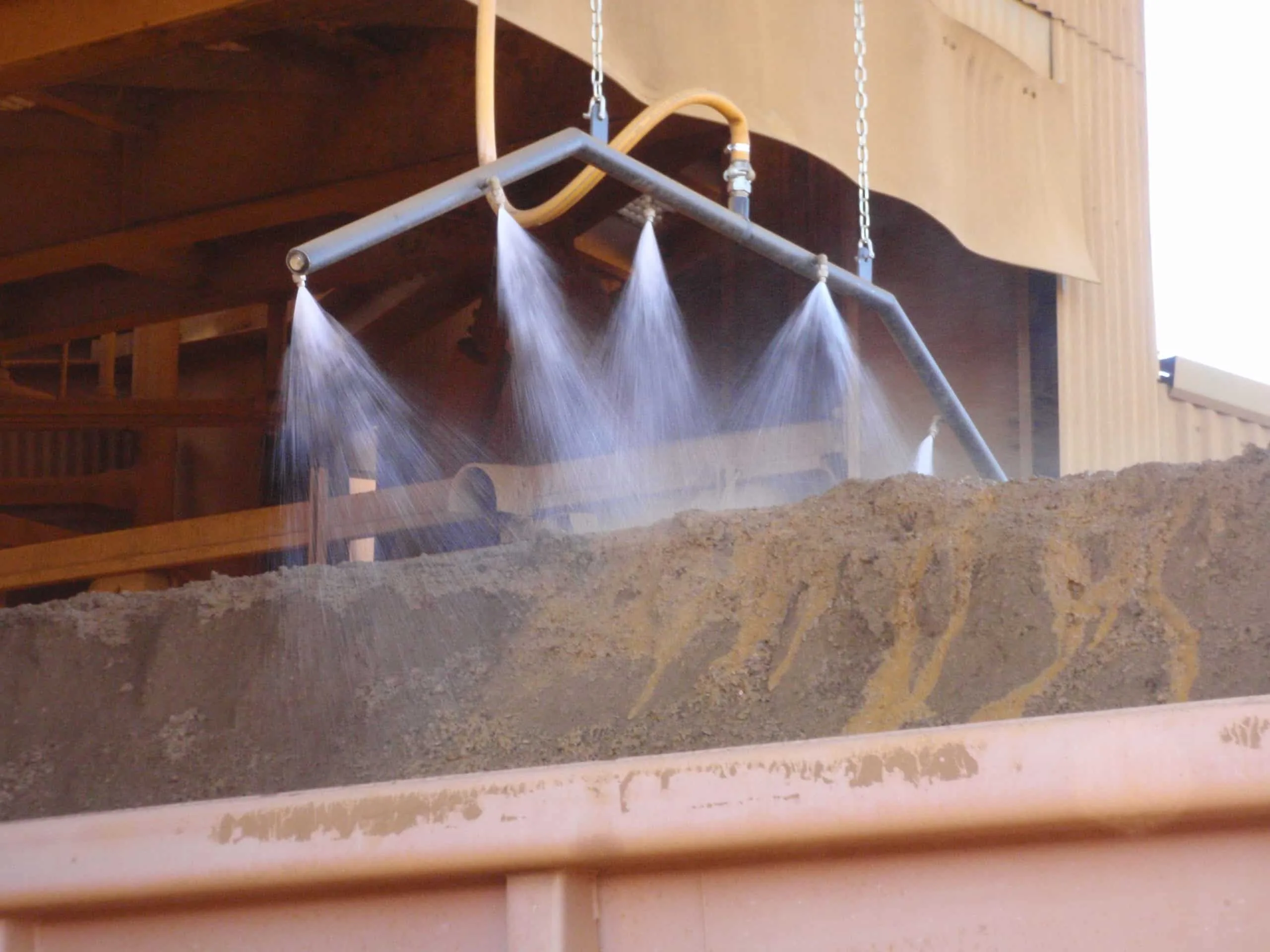
- Plain water works only while the surface stays wet
- Binders, salts and crusting agents extend control and cut water use
- Fog, fencing and enclosure reduce the amount of water needed in the first place
Spraying water is the oldest dust control method and still the most common. It is cheap to start and easy to understand. Its weakness is just as easy to understand: it stops working when it dries. On a haul road in an Indian summer that can be less than an hour after the tanker has passed.
Why plain water is often ineffective
- Evaporation. Control lasts only as long as the surface stays damp, so watering has to be repeated all day.
- Poor wetting. Fine coal and some mineral dusts are hydrophobic. Water beads on the particle instead of soaking in.
- Large droplets. A hose or tanker spray produces droplets far bigger than airborne dust, so the dust moves around them.
- Side effects. Over-watering makes roads slippery, damages the road base and adds unwanted moisture to product.
- Cost. Water tankers need fuel, a driver and maintenance, and the water itself is increasingly scarce.
Are water trucks cost-effective for dust control?
For temporary roads and small sites, yes: nothing else is as flexible. On permanent haul roads the sums change. A tanker that has to pass every hour or two ties up a vehicle and an operator for the whole shift, and coverage is uneven between passes. Fixed sprinklers or a binder programme usually cost more at the start and less over a year.
The main alternatives
| Alternative | How it works | Best suited to |
|---|---|---|
| Wetting agents (surfactants) | Lower surface tension so water spreads over dust | Coal and other hydrophobic dust in spray and fog systems |
| Hygroscopic salts | Calcium or magnesium chloride draws moisture from the air | Unpaved roads in climates with some humidity |
| Polymer and lignin binders | Glue fine particles together as they dry | Haul roads, yards and dumps |
| Crusting agents | Form a skin that resists wind | Dormant stockpiles, overburden dumps, tailings |
| Bitumen emulsions | Seal the surface with a bituminous film | Long-life treatment of low-traffic roads |
| Biological treatments | Use microbial or enzyme processes to cement soil particles | Emerging option for roads and tailings; check local evidence |
| Dry fog and misting | Capture airborne dust with very little water | Transfer points, crushers, hoppers |
| Wind fences and enclosure | Remove the wind or contain the source | Stockyards, conveyors, tipping points |
What about bitumen and biological options?
Bitumen-based products give a durable surface but raise questions about run-off and are restricted on some sites, so check your environmental conditions before using them. Biological approaches such as biocementation, where microbes help bind soil particles with mineral deposits, are being trialled on haul roads and tailings. They are promising because they add no persistent chemicals, but results depend heavily on soil type and climate. Ask for trial data from a comparable site before committing.
Can alternatives reduce water truck usage?
Yes, and that is usually the business case. A binder that holds a road surface for days instead of hours cuts tanker passes sharply. Fixed sprinklers remove the tanker from permanent routes altogether. At point sources, switching from spray to dry fog cuts water use at that point by a wide margin.
Choosing an approach
- List each dust source and how long control needs to last there.
- Check what moisture the material and the downstream process can tolerate.
- Check run-off routes and any restrictions on chemicals.
- Trial one or two options on a short section before rolling out.
- Measure water use and dust before and after so the result is clear.
Most sites end up with a mix: fog at the plant, sprinklers on the yard, a binder on the roads and a tanker kept for the places that move.
Frequently asked questions
What are the alternatives to water for dust control?
Wetting agents, hygroscopic salts, polymer and lignin binders, crusting agents, bitumen emulsions and biological treatments, along with fog systems, wind fences and enclosure.
Why is plain water ineffective for dust control?
It evaporates quickly, its droplets are often too large to capture fine dust, and it does not wet hydrophobic materials well.
Which dust control method is most cost-effective in the long term?
It depends on the source, but on permanent roads and yards, fixed systems and binders generally cost less over time than repeated tanker watering.